
$mart Ba$ket
April 2019
What is $mart Ba$ket?
$mart Ba$ket is an application that helps people to organize their expenses based on imported receipts and tracking their shopping habits. Further, it offers a smart shopping list that is generated based on the user’s consumption period.
Why $mart Ba$ket?
-
People who tend to track their expenses complain about the pile of paper receipts.
-
People don’t know when they are running out of groceries.
-
People forget about their previous shopping items.
-
People don’t know how much food they might need according to their consumption habits.

Is there any more baking powder in the cabinet?
Should I buy cheese today or waiting for it late?
How much milk is left in the refrigerator?
Goal
To develop an application that tracks user's shopping expenses based on his/her shopping receipts and to suggest using a list of items that he/she might be out of them based on shopping habits.
Objectives
-
Scan, categorize and manage shopping receipts
-
Track grocery shopping habit
-
Track shopping expenses
-
Generate statements of household consumption based on product consumption period.
To gain a better understanding of my target audience I initially created an online survey. Specific questions asked to figure out the essential features and content to include in the app.
User Research
Survey Highlights
Key Findings
-
The majority of users use the iOS platform vs. Windows, Android, or other platforms.
-
About 67% of users ask and give their shopping receipts from the cashiers.
-
About 36% of users go for grocery shopping to buy their regular requirements every two weeks.
-
About 42% of users often forget when they are going to run out of some grocery items.
-
The majority of users need to stop by more than three stores for their regular grocery shopping.
-
More than 40% of users couldn’t finish their grocery items before they getting expired.
-
A little more than 30% of users shop some items again that they forgot that they already have them.
-
More than 56% of people use the shopping list to buy their grocery items.

“How can I manage all these?”
Ideate
Persona

“I like being organized and planning my day so I can stay on top of my busy schedule and maintain a work-life balance.”
Jason is very protective and organized when it comes to his busy schedule. He is an overachieving and bubbly undergraduate at San Jose State University, always helping others and improving the environment around him. He is currently studying Information Systems with a minor in Mathematics. When he’s not studying for his midterms, he is a star athlete on the Track and Field team. Outside of school, he enjoys going on his routine trips to the local grocery store and cooking healthy meals to stay fit.
Grocery Shopping Habit
Jason shops bi-weekly and primarily go to closer stores but sometimes ventures out for more variety. He usually buys convenient and common necessities, and so there are many repeats/routines in purchases.
Unmet Need
Jason is frustrated with not finding a way to efficiently organize his grocery shopping list to meet his shopping habits.
Jason
Age: 20
Occupation: Undergraduate Student
Major: Information Systems
Location: San Jose, California
Intraction design
Low fidelity wireframe
It took me a couple of iterations to get my paper prototypes ready to test with the target users. From users' feedback on my initial sketches and based on Personas, I decided to focus on two main actions/tasks only:
-
Create to-do-list and create a wish list
-
Generate a new list based on users' mood
So after Sign-up/Login users will be directed to the Home screen where they have 3 options.
-
Search or add the activity and create lists for the first time
-
Import the mood and get the new list by artificial intelligence after login.

High fidelity wireframe
In this side project, the Balsamiq app helps me to make the wireframes more obvious and testable.


High fidelity sketches
Design A


Design B




Usability A/B Testing
Users' Feedbacks
-
Users collaborate with the app to generate a shopping list.
-
Users manage their shopping expenses.
-
The application tracks users shopping habits through the amount of consumption.
-
The application makes an overview of all the items that the user needs soon.
-
Users make their own shopping lists based on an overview of the items discovered by the application.
-
Users find Different ways to import the receipts in design B.
-
Users Share the shopping list with others.
-
Users find the ability to edit the period of consuming, the number of groceries, changing the stores, and etc.
-
Users find the ability to add some items in routine mode or non-routine.
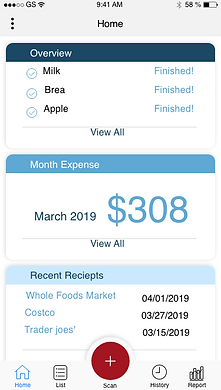
Users need more options to import the receipts.


Users find Account managing at the top left useful.


The History lists based on dates are more functional than the store lists.
Successful Design B
Based on users’ feedback: on A/B testing, Design B was successful because of:
-
Shrink the receipts history based on last updates.
-
Three ways to upload receipts.
-
A feature that show the monthly cost.
-
Account setting at top left of home screen.
-
Button for on and off the routine and non routine items from the shopping list reminder.
Final Product
The idea of $martBa$ket came to my mind when I found how many people complain about the pile of paper receipts, forget about their previous shopping items or running out of groceries. They don’t know how much food they might need according to their consumption habit.
Then I decided to develop an idea as an application that save people shopping habits and generate new list for their next coming groceries shopping.
Smart Basket is an interactive mobile application with AI system which is offer a shopping list based on imported receipts and tracking their shopping habits. the artificial intelligence offers a smart shopping list that is generated based on user’s consumption period.
Prototype with Adobe XD

Interaction with Protopie
